

Since a public “situation with outstretched arm” has caused not only some justified irritation, but also apparently a great deal of uncertainty in the media as to how it should be interpreted, and since all sorts of all-too-vague historical analogies have been used to explain it, perhaps it’s about time to recapitulate and refresh the history of the so-called Roman salute. It is a responsibility of History as academic discipline, it is our responsibility as historians to set these things straight, immediately, to not allow rewriting the past to change conditions in the present. If nothing is true, everything’s allowed.
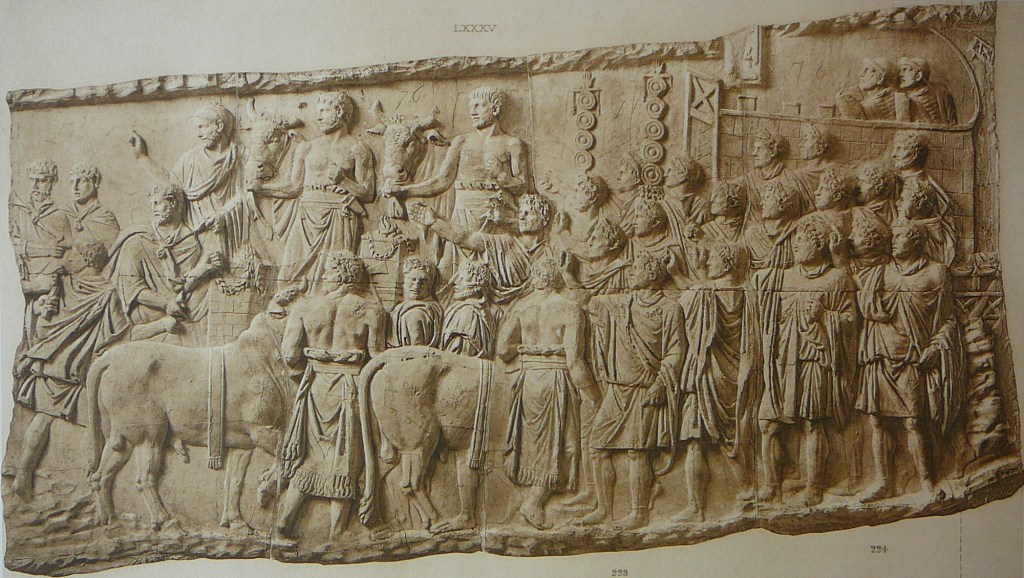
However often one thinks of the Roman Empire, excusing a Fascist salute by identifying the gesture as some kind of ancient “Saluto Romano” is even more awkward when one considers that there is no ancient source that would clearly describe such a thing. There’s an ambiguous depiction of an outstretched arm on Trajan’s Column in Rome, and a rather vague passage in Josephus’ Bellum Iudaicum (the latter doesn’t even specify what the salute looks like). And that’s about it.
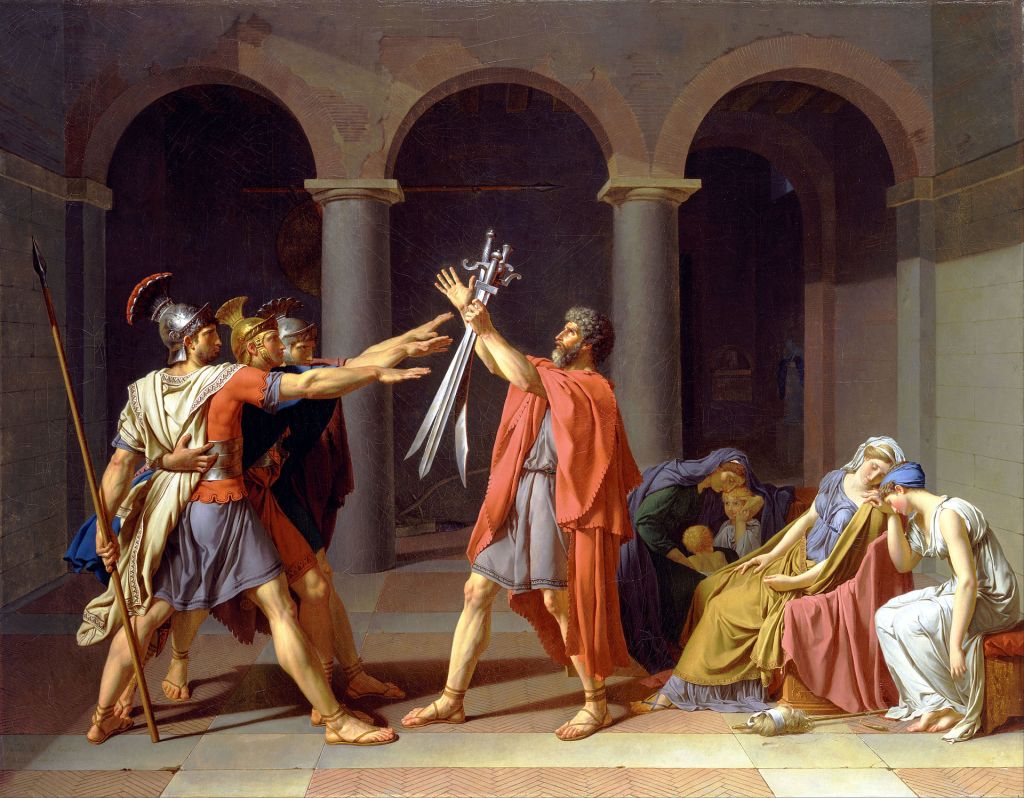
The Roman salute, which most people seem to think of as an ancient greeting, only really becomes tangible in … the visual arts of the 18th and 19th centuries. Think of opulent and pompous oil paintings such as Jacques-Louis David’s “Oath of the Horatii” from 1784 and you have the (probably most prominent) image of that gesture. But also the challenge it poses. Because here it’s not a greeting, it’s an oath.
From there, the gesture gained wider attention when theatre plays and “sword-and-sandal” genre films in the beginning 20th century popularized it as an alleged form of ancient greeting. “Ben Hur” for example, which premiered on Broadway in 1899 and has been followed by numerous movie adaptations since, probably had its fair share in contributing to this vision.
But, of course, it was 20th-century fascism that subsequently appropriated that very gesture. Another genre movie, a 1914 Italian silent film epic called “Cabiria” by Giovanni Pastrone, seems to play a key role here. Again, it famously shows the gesture as a “Roman greeting”. And its screenwriter, Gabrielle D’Annunzio, certainly comes with his own history: Poet, playwright, journalist, aristocrat, and army officer – you name it and you can bet he’s been there. He was also the driving force behind the occupation of Fiume (now Rijeka in Croatia) in 1919 as part of an Italian nationalist reaction to the Paris Peace Conference after World War I. In reference to the Italian stormtroopers during this Great War, the irregulars he led called themselves “Arditi” (while he himself acted as “Duce” of a short-lived Italian Regency of Carnaro in Fiume). D’Annunzio introduced, and here we finally return to the movie, the “Saluto Romano”, which he had already used in the screenplay under this name, as the signature greeting of these troops. It was eventually adopted (along with their uniforms and insignia) by Mussolini and his paramilitary fascist “Blackshirts” – and in turn copied by Hitler and the Nazis.
And it was they who ultimately inscribed the salute with outstretched arm in our shared cultural memory as a symbol of terror and annihilation for all time. We do not act in a cultural vacuum: No action is detached from the social context of its present, no symbolism could be read without the continuously updated subtext of its own history.
Note: While this short article barely offered a glimpse into the background of what’s been labelled as “Roman Salute”, a much deeper and more thorough history can be found in Martin M. Winkler’s scholarly treatise on the topic published with Ohio State University Press in 2009. The book is available online in open access via Project Muse.
 Trowel & Pen