
Current headlines read like the plot of one of those pulp adventure films shown on late-night TV: Adventurer discovers Ark! But this isn’t about that adventurer. And it isn’t about that Lost Ark. It’s another Old Testament myth: Noah’s Ark. – Yes, the boat in which, according to religious tradition, the biblical patriarch Noah survived the Great Flood (when God regretted “how great the wickedness of the human race had become on the earth”), together with his wife, their sons, those wives, and a considerable number of animals (two of each kind – well, you know the story). Once the waters had receded, the ark is said to have finally run aground “on the mountains of Ararat”. And according to a lot of recent media excitement, it has finally been found. Again. But is it really? (Spoiler: The answer’s: No. Again.)
Various locations have been discussed over the years for the final resting place of Noah and his family, and the supposed remains of their ship have been ‘discovered’ in many different places. These include the Durupınar rock formation not far from the town of Doğubeyazıt in Türkiye. Located less than 30 kilometres south of Mount Ararat (which, for the record, is not necessarily identical to the mountain range mentioned in the biblical account), the formation lies at an altitude of 2,004 metres on the flank of the Tendürek Dağı volcano. Some have considered it to be the possible resting place of the Ark for decades. So this news is not really new. Originally discovered by a Kurdish shepherd, the formation was identified by Turkish army captain and cartographer Ilhan Durupınar in an aerial photograph taken in October 1959 after heavy rainfall and earthquakes had exposed it already eleven years earlier, in 1948. Since then, the idea that this ‘boat-shaped formation’ contains the remains of Noah’s Ark has persisted.
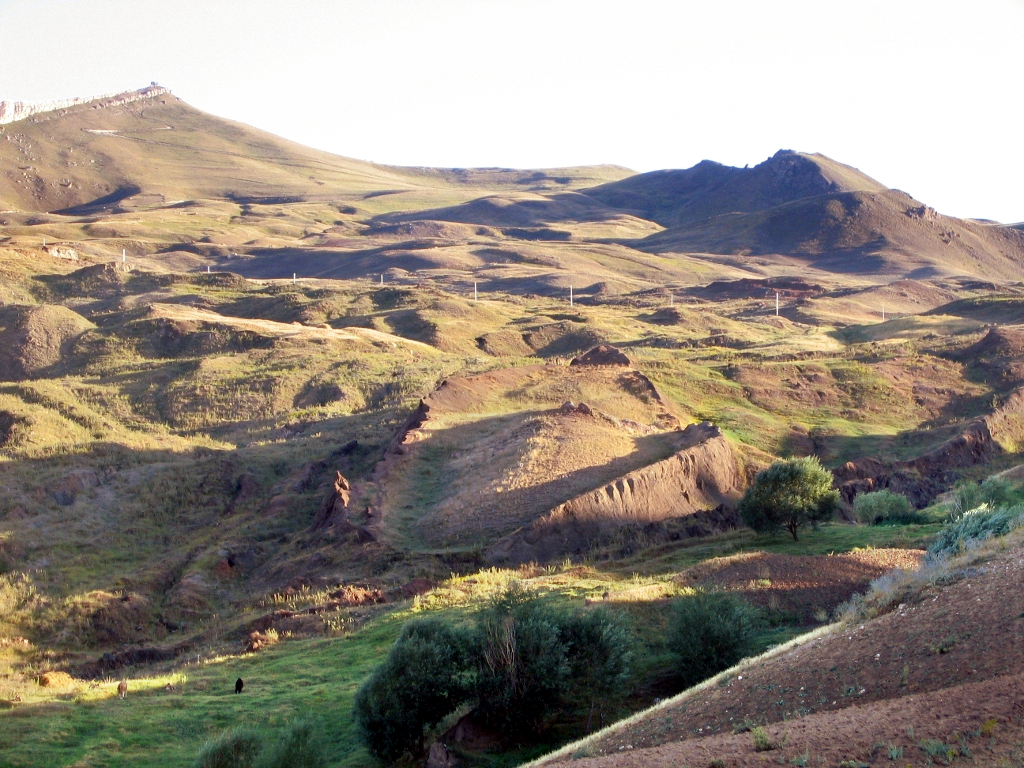
Photo: Mfikretyilmaz, CC BY 3.0
The geophysical investigations on site, which recently made headlines, are not actually brand new either. These surveys, which included ground-penetrating radar and electrical resistivity tomography, were carried out in autumn 2021, according to Noah’s Ark Scan Group, the US-based private research collective in apparently creationist tradition behind this enterprise. Rectangular structures are said to have been documented on three levels, corresponding to the three decks of the Ark in the biblical account. That’s what it says. In numerous media reports. However, the published radar images primarily reveal a series of local signals at different depths. The fact that these appear to follow the surface topography is nevertheless consistent with the results of earlier investigations.
In fact, these are not the first ground-penetrating radar scans to be carried out here. Several similar surveys have been conducted since the 1980s. But these have not produced particularly useful results. In contrast, they basically added to geological survey’s on-site findings that the conspicuous formation is of natural origin. Geological mapping indicates a fault in the subsurface immediately to the west of the formation. The supposed ship walls thus appear to have been formed by earth movements along this fault. Therefore, it is no coincidence that the structure first became visible after an earthquake in 1948 and that their relief became more pronounced compared to the surrounding terrain following another one in 1978. Gradual erosion, rainfall, and loose earth sliding down the sloping terrain then contributed to its formation. The dynamic mud flow found its way around the stable bedrock, which had been pushed upwards by the earthquakes, ultimately modelling the streamlined boat shape. This also explains why more detailed investigations of the supposed ‘ship walls’ have revealed only mud and local rock, and why every supposed find of fossilised wood has ultimately proved to be the product of natural soil formation. Alleged ship frames and planks were found to be andesite and basalt of volcanic origin, and a metal detector merely confirmed the presence of natural concentrations of ferrous rocks, rather than revealing numerous rivets along a ship’s hull.
All of this should encourage us to adopt a more cautious approach amid the media excitement surrounding this supposed discovery. This criticism does not rule out the possibility that the published ground radar images hint at traces of earlier human activity. Only a detailed analysis – and, if necessary and appropriate, excavation – can reveal whether this is the case and determine the nature of any possible remains. In fact, excavation has already been announced. Conversely, this does not prove that the Ark from the biblical flood myth can be located here, nor does it prove the flood itself. The tradition of a religious myth is not sufficient to support the claim that it depicts historical events or to locate them physically. In any case, identification as Noah’s Ark would require more substantial evidence than vague signs of ground changes in a radar image. Interpretation of such findings comes at the end of the research process, emerging when all available data are summarised. Anticipating this result and starting with the conclusion (that this would be indeed Noah’s Ark) is simply pseudoscientific because it subordinates the findings to the interpretation, rather than the other way around.
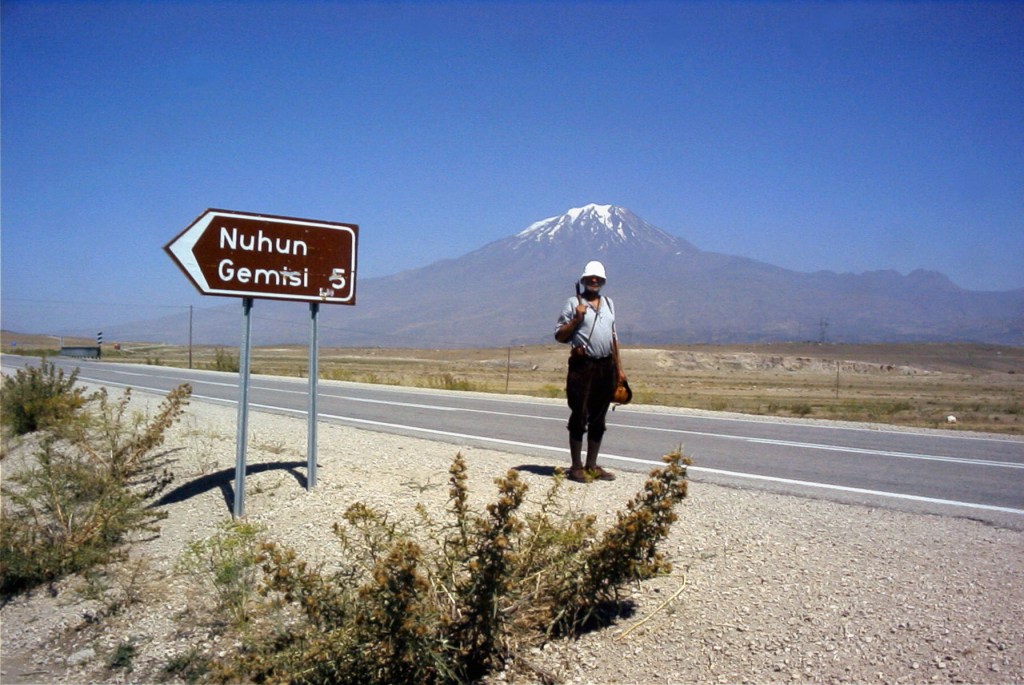
Photo: Aaboelela,CC BY-SA 3.0
In my opinion, the history of how this location has been perceived is far more interesting than trying to prove a myth that defies all evidence. The Durupınar formation is now located within an official national park, and the Nuhun Gemisi (“Noah’s Ark”) has become a tourist attraction. Regardless of whether this claim is verifiable or true, the site plays an important role in the perception of those who believe in the myth, and it would be interesting to trace how much of this is due to continuous media coverage. After all, at Durupınar there’s not the only boat-shaped structure of its kind in the area’s mudflow material, nor is it the only place where alleged remains of Noah’s Ark have been identified.
Are we going to end up with a whole fleet of arks?
 Trowel & Pen